






About Electro Houshmand Dimand
Electro Houshmand Dimand Technical and Engineering Company was established in 2012 with the aim of consulting and implementing industrial automation projects. Our colleagues in this group have more than 15 years of experience in implementing industrial automation projects. Our view at Electro Houshmand Dimand company has always been to implement new automation solutions in various automation pyramids for our customers, and in line with this goal, we have especially turned to implementing ERP-MES-SCADA-PLC-Field systems.
Industrial automation and HMI programming
In the world of industrial automation, programmable logic controllers, or PLCs, make equipment factories for specific controller products. The field of automation has grown tremendously over the decades, but humans play an important role in operating, troubleshooting, and maintaining these complex systems.
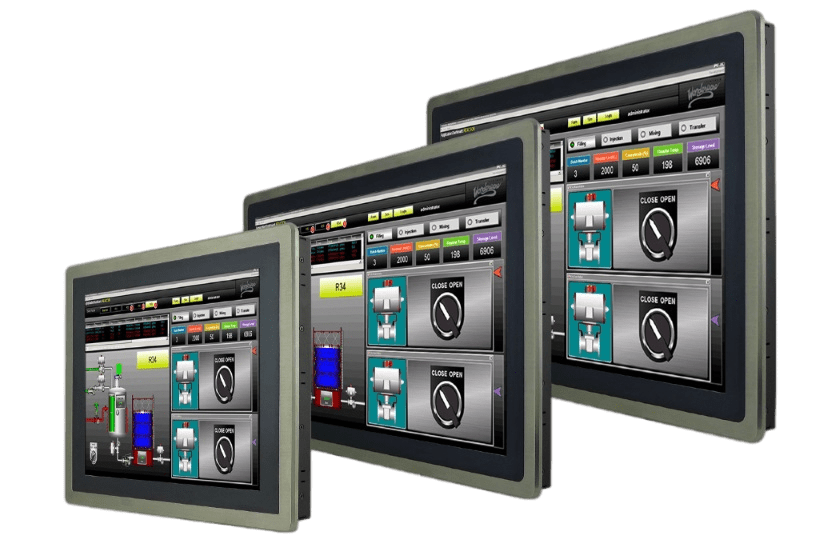
A human machine interface, or HMI for short, is a device that allows a human to provide feedback from a PLC that controls the manufacturing process. In other words, it’s a tool to input commands to your machines and get feedback on their status. Simply put, HMI is an industrial computer that is properly placed to communicate between the PLC and the operator of the production floor.
HMI programming
HMI programming is different from most other programming languages. That’s because the HMI is a visual representation of what’s happening in production. Therefore, actual HMI programming is usually referred to as HMI development, as more time is spent designing screens than coding in the traditional sense.
Additionally, the programming that controls the input and output of an HMI generally resides on the PLC, giving the PLC programmer more control over how the HMI functions. However, both of these functions are combined in most facilities, and the PLC programmer either creates the layout of the HMI screens or is familiar enough with the process to determine how to implement the HMI programming.
HMI Programming: Basics and Advanced Features
The most basic HMI allows the operator to see the current status of a particular process. Imagine for a moment that you have a grinder that you can start and stop with the push of any button. An HMI can be created to provide a visual indication of the current state of the device: stopped or running. However, a PLC can extract much more information from this device depending on the operation’s needs. Therefore, the HMI can be used to communicate this information to the operator, allowing him to make better decisions regarding the process.
Imagine that the same grinding machine is capable of breaking down. It may stop due to lack of maintenance (low oil level), unanticipated failure (inlet jamming), or operator error (open safety door). Each of these fault conditions is displayed by an LED directly on the switchboard. Since we have this information available, we may choose to add it to an HMI to provide a more granular feedback mechanism to the operator that eliminates inherent error.
Another example of HMI programming
Now imagine that the device has several features that may be set by the operator. This may include settings for speed, temperature, speed, and more. Each of these settings used to be adjusted through a series of potentiometers. Now, many of these can be changed directly from an HMI. We want to quickly note that good HMI design practices suggest that some HMI features may be restricted to different users. For example, an operator must be able to start, stop and select the speed of the machine. They should not be able to change the settings according to the temperature that may affect the final product. This setting may be limited to a supervisor or engineering level personnel.
Finally, an HMI can include advanced process features such as batch control, recipe management, line status, and much more. As HMIs became more powerful, they evolved from controlling a single machine to plant-wide control schemes, sometimes described as supervisory control and data acquisition systems, or SCADA. There is a gray line where an HMI is considered a SCADA system, but for your understanding, and the HMI controls a single production line. In contrast, a SCADA system monitors an entire area or entire manufacturing plant.

No comment